


When you think about nighttime pollution, you probably imagine traffic fumes, factories, or city air. What most people never consider is the object their face rests on for eight hours every night. Mattresses look harmless. They feel soft, comforting, and familiar. But many conventional mattresses release chemicals into the air while you sleep, even if you cannot see, smell, or detect them. Your lungs can feel them, though, and your health often does too.
The truth is simple. The materials inside your mattress decide the quality of the air you breathe for one third of your life. And once you understand what goes into a typical foam mattress, it becomes clear why organic materials are becoming a safer, healthier choice for so many homes.
Here is what really happens while you sleep, and why choosing cleaner materials can make a huge difference.
The chemicals that exist in regular mattresses
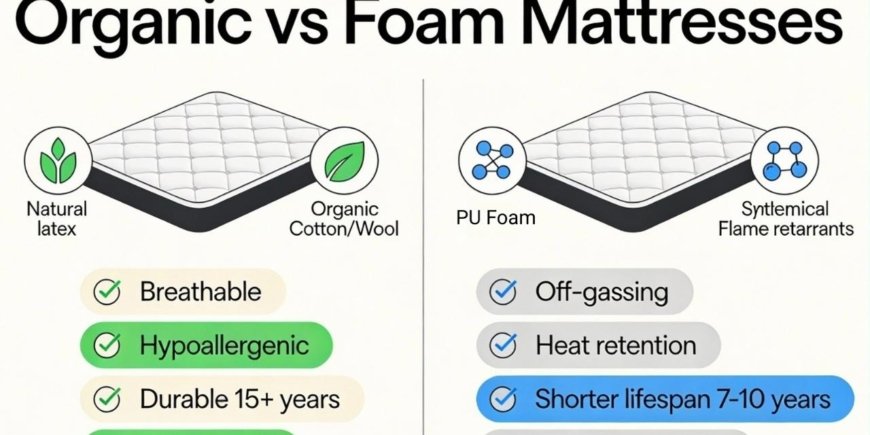
Most standard mattresses are built using polyurethane foam, chemical adhesives, synthetic fillings, and industrial flame retardants. These ingredients release volatile organic compounds, better known as VOCs, into the air. VOCs evaporate continuously, especially when exposed to heat. That familiar “new mattress smell” is not freshness. It is VOC evaporation.
Some of the most common chemical sources include:
- VOCs from polyurethane foam
- Flame retardants such as PBDEs
- Formaldehyde from adhesives
- Petrochemical based foams and fillers
Polyurethane foam is especially reactive. As it ages, it oxidizes and releases even more VOCs into the surrounding air. PBDEs are now restricted in several countries, but many mattresses still contain similar flame retardants whose long-term endocrine effects are still being studied.
It may look like a simple mattress, but chemically it behaves more like a slow-releasing vapor source inside your bedroom.
How chemical exposure affects health
Breathing in chemical vapors for hours at a stretch can have a significantly greater impact than most people realize. VOCs can irritate the eyes, nose, and throat. They are linked to headaches, dizziness, low-quality indoor air, and discomfort that disrupts sleep cycles. Many people wake up with dryness, irritation, or mild congestion without ever connecting it to their mattress.
Over time, the effects can extend further. Several NIH-backed studies have linked chronic VOC exposure to hormone disruption and increased sensitivity in the respiratory system. Children and older adults are even more vulnerable because their breathing rates tend to be higher, which leads to greater chemical intake relative to their body weight.
If you have ever experienced morning headaches, unexplained fatigue, or irritation that feels worse at night, your mattress may be contributing more than you think.
Off-gassing is strongest at night
One of the reasons mattress-related chemical exposure goes unnoticed is timing. Off-gassing from foam tends to intensify when the mattress is warm. Body heat accelerates the release of VOCs, which means vapor levels rise exactly when you lie down to sleep.
Your face is only a few inches away from the mattress surface. At night, your breathing becomes deeper and more consistent, which increases the amount of air you pull directly from the space around the mattress. A synthetic foam mattress can emit the highest concentration of chemicals during the exact hours when your lungs are resting and most vulnerable.
Even people who have no issues during the day often feel discomfort at night because the release of vapors increases as their body warms the foam.
Why organic mattresses are safer
Organic mattresses eliminate these concerns by removing the chemical sources entirely. They are made with natural latex tapped from rubber trees, breathable organic cotton, and temperature-regulating wool. None of these materials rely on petrochemicals, chemical adhesives, or synthetic flame retardants.
Wool acts as a natural fire-resistant fiber, which means chemical retardants are not required to meet safety standards. Natural latex does not off-gas and does not break down into micro particles the way synthetic foam does.
When you remove synthetic foams, harsh glues, and industrial additives from your mattress, you remove a major source of indoor pollution from your home.
Better for children, the elderly, and sensitive individuals
Some groups are more sensitive to chemical exposure than others. Children inhale more air per kilogram of body weight, which means they absorb chemicals more quickly. Elderly individuals and people with asthma, eczema, or allergies often react strongly to VOCs because their respiratory systems are more delicate.
An organic mattress provides a cleaner, safer environment for anyone with sensitive lungs or skin. Fewer irritants in the air mean fewer nighttime triggers, calmer breathing, and deeper, uninterrupted rest.
For families, this can be life-changing. For individuals with chronic sensitivities, it can feel like finally being able to sleep without fighting the air around them.
A cleaner mattress means cleaner sleep
The simplest question to ask is this: if you wouldn’t spray chemicals in your bedroom right before sleeping, why breathe them in for hours through your mattress?
Choosing an organic mattress is not about trends or aesthetics. It is about creating a sleep environment that supports your health, rather than challenging it. When the air you breathe at night is cleaner, your sleep becomes deeper. Your mornings become lighter. Your body feels calmer. And your home becomes healthier in a way that lasts for years.
A mattress is more than a place to lie down. It is a source of air, comfort, and restoration every single night. Choosing an organic one is one of the most straightforward ways to protect the quality of your sleep and, by extension, the quality of your life.
There are no comments